Quick answer
WordPress vs Shopify for an online store in India: which is better?
In the WordPress vs Shopify for online store India choice, Shopify is usually better if you want a store that is quick to launch, with hosting, security and updates handled for you. WordPress with WooCommerce is usually better if you want full control, a lot of content and blogging, or custom features. Both support UPI, cards, COD and GST settings.
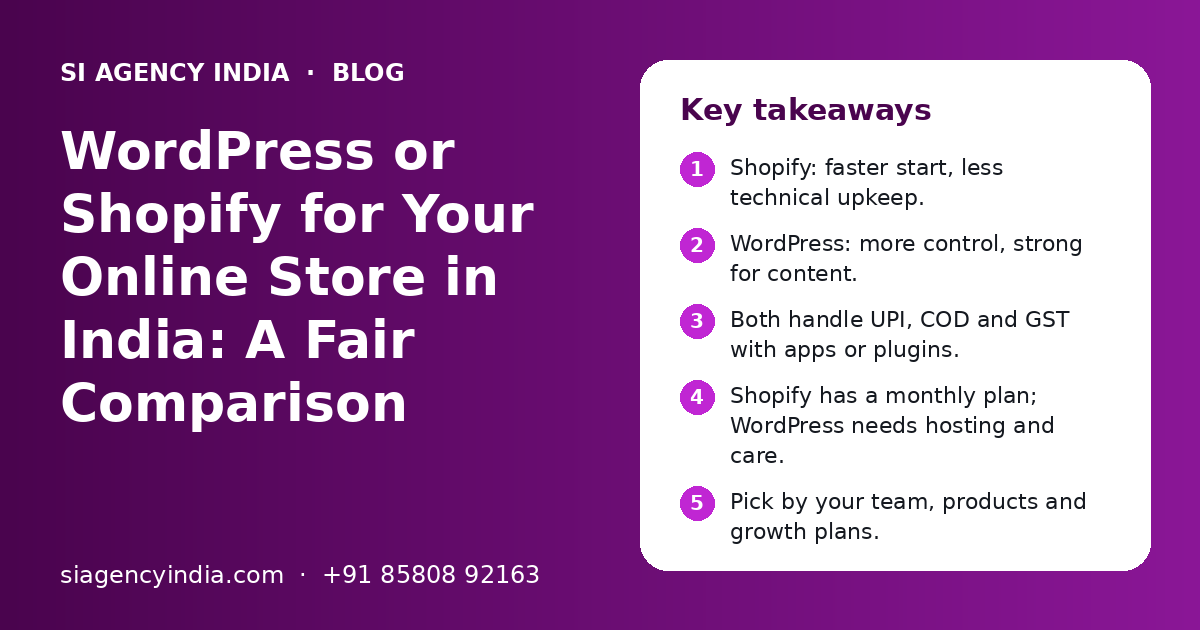
Key takeaways
- Shopify: faster start, less technical upkeep.
- WordPress: more control, strong for content.
- Both handle UPI, COD and GST with apps or plugins.
- Shopify has a monthly plan; WordPress needs hosting and care.
- Pick by your team, products and growth plans.
- You can move later, but plan URLs and SEO first.
WordPress vs Shopify for an online store in India: what is the real difference?
The real difference is who runs the technical side. Shopify is a hosted service that looks after hosting, security and updates for you. WordPress with WooCommerce is free, open-source software that you install on your own hosting, so you control everything but also look after it.
Neither choice is wrong. The sections below compare each part that matters for an Indian store.
How do WordPress and Shopify compare side by side?
Shopify wins on ease of setup and low technical upkeep. WordPress wins on control, flexibility and content. The table below gives a quick view before we look at each point in detail.
| Point | Shopify | WordPress + WooCommerce |
|---|---|---|
| Setup | Quick, guided setup | Needs hosting, install and setup |
| Hosting and security | Handled by Shopify | You or your agency manage it |
| Software updates | Automatic | Core, theme and plugins need regular updates |
| Design control | Themes plus custom code in Liquid | Full control over theme and code |
| Blog and content | Basic blog built in | Very strong, WordPress began as a blog tool |
| Extra features | Shopify App Store | WordPress plugin directory and custom code |
| Ownership | Data can be exported, platform stays Shopify | You own the files, database and hosting choice |
| Best for | Brands that want to focus on selling | Businesses that want control or heavy content |
If you want more detail on each platform on its own, see our Shopify store development and WordPress website development pages.
Which is easier to set up and manage for a small team?
Shopify is easier for most small teams. You sign up, pick a theme, add products and connect payments from one admin panel, without thinking about servers or updates.
WordPress is not hard to use once it is set up well. Many owners find the WordPress editor simple. But someone must choose good hosting, install WooCommerce, pick a theme and plugins, and keep all of them updated. If nobody in your team is technical, you will need a developer or an agency for this.
Daily tasks your team will do
- Adding products, photos, prices and stock: easy on both.
- Processing orders and printing labels: easy on both, with shipping apps or plugins.
- Fixing a broken plugin or a slow server: Shopify users rarely face this; WordPress users sometimes do.
Do both platforms support UPI, COD and GST for Indian buyers?
Yes. Both platforms can take UPI, cards, net banking and wallets through Indian payment gateways, offer cash on delivery, and handle GST settings. The setup steps are a little different.
Popular Indian gateways such as Razorpay, PayU and Cashfree offer a Shopify app and a WooCommerce plugin. COD is built into both platforms. For GST, both let you set tax rates, and you can add an app or plugin to create GST-ready invoices with your GSTIN, HSN codes and the right tax split.
| Indian need | On Shopify | On WordPress + WooCommerce |
|---|---|---|
| UPI and cards | Gateway app from an Indian provider | Gateway plugin from an Indian provider |
| Cash on delivery | Built-in manual payment option | Built-in payment option |
| GST rates | Tax settings in admin | Tax settings in WooCommerce |
| GST invoice with GSTIN and HSN | Invoice app | Invoice plugin |
| Courier booking and tracking | Shipping aggregator apps | Shipping aggregator plugins |
| WhatsApp order updates | Apps or WhatsApp API link | Plugins or WhatsApp API link |
One point to check on Shopify: on some plans Shopify may add its own transaction fee when you use an outside payment gateway. Read the current plan details on the Shopify website before you choose a plan. On WooCommerce, you pay only your gateway's fees, but you pay for hosting and care instead.
For a full list of what an Indian store needs at checkout, read our ecommerce website development page.
Which platform is better for SEO and content?
WordPress is usually stronger for SEO and content, because it gives you full control over pages, URLs, blogs and technical settings. Shopify is also good for SEO and covers the basics well, but it has a few fixed rules.
Shopify SEO strengths
- Fast, secure hosting by default
- Clean product and collection pages
- Editable titles, meta descriptions and alt text
- Sitemap made automatically
Shopify SEO limits
- Fixed URL patterns like /products/ and /collections/
- Blog tools are basic compared to WordPress
- Some changes need apps or theme code
- Less control over some technical files
If you plan many buying guides or articles in Hindi or other Indian languages, WordPress gives you more room. If most traffic will come from ads, Instagram and marketplaces, Shopify's SEO is enough.
In both cases, results depend more on your content, speed and product pages than on the platform. Our SEO services in India cover both Shopify and WordPress stores.
Need help with your project?
Talk to the SI Agency India team. Free first call, simple advice, clear quote.
What affects the cost of a WordPress or Shopify store?
The cost of both depends on design, number of products, features, apps or plugins, and ongoing care. Shopify has a regular monthly plan and app fees. WordPress has no licence fee, but you pay for hosting, premium plugins and maintenance.
| Cost factor | Shopify | WordPress + WooCommerce |
|---|---|---|
| Platform | Monthly or yearly plan | Software is free |
| Hosting | Included in plan | Separate hosting plan |
| Theme | Free or paid theme | Free or paid theme |
| Extra features | Many apps have monthly fees | Many plugins are free; premium ones have yearly fees |
| Custom design or features | Liquid and app development | PHP and plugin development |
| Upkeep | Low technical upkeep | Updates, backups and security care |
| Payment fees | Gateway fees, and on some plans a Shopify fee | Gateway fees |
Do not compare only the starting cost. Add up the yearly cost of the plan or hosting, apps or plugins, and care for at least two to three years. Then compare.
Our website cost in India guide explains these cost factors in more detail. We do not share fixed prices in articles. You get a clear quote after a free call, based on your products and features.
Which platform handles growth, sales spikes and custom features better?
Shopify handles traffic spikes, such as a festive sale or an influencer post, without you managing servers. WordPress can handle growth well too, but it needs good hosting, caching and a clean build.
For custom features, WordPress is more open. You can build almost anything, such as B2B price lists, dealer logins, custom quote forms or a link with your ERP. Shopify can do a lot through apps and its developer tools, but some deep changes, such as fully changing the checkout, depend on your plan and Shopify's rules.
D2C brand with festive sales
Shopify is often the easier fit. Steady speed during spikes and many marketing apps.
Manufacturer or B2B seller
WordPress often fits better. Custom price rules, quote forms and a large catalogue with specs.
First-time seller
Shopify is often easier. Less to set up and fewer technical tasks.
If you sell on Amazon or Flipkart too, both platforms can connect with marketplace tools. For growth after launch, see our D2C ecommerce marketing page.
How do you choose between WordPress and Shopify, step by step?
Choose by looking at your team, products, content plans and budget for upkeep, not by what a friend or a video says. These steps help you decide in a clear way.
- 1
List your products and rules
Note how many products, variants, sizes and any special pricing, such as wholesale or bulk rates.
- 2
Check your team's skills
If nobody is technical and you do not want a care plan, lean towards Shopify.
- 3
Decide your traffic plan
If you plan a lot of blog and SEO content, lean towards WordPress. If ads and social will lead, either works.
- 4
List must-have features
UPI, COD rules, GST invoices, courier links, WhatsApp updates, multiple languages, B2B logins.
- 5
Check apps or plugins for each feature
Make sure each feature is available and supported on your chosen platform.
- 6
Add up the yearly cost
Compare plan or hosting, apps or plugins, and maintenance for two to three years.
- 7
Decide who owns the accounts
Keep the store, domain, hosting and gateway accounts in your business name.
Can you move from WordPress to Shopify, or from Shopify to WordPress, later?
Yes, you can move in either direction. Products, customers and orders can be exported and imported. But a move takes planning, because URLs change and you can lose search rankings if redirects are not set up.
- Export products, customers and order history.
- List every old URL, especially product and category pages.
- Set up 301 redirects from each old URL to its new URL.
- Rebuild key features, such as GST invoices and COD rules, on the new platform.
- Test checkout, payments and emails before switching the domain.
- Watch Google Search Console for errors after launch.
Our post on website migration without losing SEO explains these steps in detail. If you are not sure, it is better to choose carefully now than to move in a year.
Whichever platform you pick, keep it healthy after launch. Our website maintenance services cover updates, backups, speed checks and fixes for both platforms.
How can SI Agency India help you choose and build your store?
We can look at your products, team and plans on a free call and tell you which platform fits better, with honest reasons. We build on both Shopify and WordPress, so we have no reason to push one.
Our parent team, Shivah Web Tech, is a Shopify Partner with 11+ years of experience and 500+ projects. We work with sellers across India online from our Mohali office, Monday to Friday, 9:30 to 6:30 IST. Your store, domain and payment accounts always stay in your name.
Contact us to book a free store planning call. You get a clear quote after the call.
Frequently Asked Questions
Is Shopify or WordPress better for a small online store in India?
For a small store with a non-technical team, Shopify is often easier because hosting, security and updates are handled for you. WordPress with WooCommerce is a good choice if you want more control, plan to write a lot of content, or already have a WordPress website. Both can take UPI, cards and COD and handle GST settings.
Is WooCommerce the same as WordPress?
Not exactly. WordPress is website software used to build all kinds of sites. WooCommerce is a free plugin that adds a full online store to a WordPress site, with products, cart, checkout, payments and orders. When people compare WordPress and Shopify for ecommerce, they usually mean WordPress with WooCommerce.
Can I take cash on delivery on Shopify and WooCommerce in India?
Yes. Both platforms have a cash on delivery option you can turn on. You can also add apps or plugins to set COD rules, such as limiting COD to certain pin codes or order values, or sending an OTP or WhatsApp check before the order is confirmed. This helps reduce fake or refused COD orders.
Which platform is cheaper to run, WordPress or Shopify?
It depends on your store. Shopify has a monthly plan and many apps have monthly fees, but technical upkeep is low. WordPress software is free, but you pay for hosting, premium plugins and regular maintenance. The fair way is to add up the full yearly cost of each for two to three years. You get a clear quote from us after a free call.
Can I create GST invoices on Shopify and WordPress?
Yes. Both let you set GST tax rates. To create proper GST invoices with your GSTIN, HSN or SAC codes and the CGST, SGST or IGST split, you usually add an invoice app on Shopify or an invoice plugin on WooCommerce. Ask your accountant to check the invoice format before you go live.
Is Shopify good for SEO in India?
Yes, Shopify is good for SEO basics. It gives fast hosting, clean pages, editable titles and descriptions, and an automatic sitemap. It has fixed URL patterns and a simpler blog than WordPress. If content and blogging are a big part of your plan, WordPress gives more control. Either way, good content and product pages matter most.
Can I switch from WooCommerce to Shopify later?
Yes. Products, customers and orders can be moved with export files or migration tools. The important part is SEO. You must map every old URL to its new URL and set up 301 redirects, or you can lose rankings. Also rebuild features like GST invoices, COD rules and shipping links, and test everything before you switch.
Do I own my store on Shopify?
You own your business, brand, domain and data, and you can export products, customers and orders. But the store runs on Shopify's platform under its terms, so you cannot move the Shopify system itself to other hosting. With WordPress, you own the software files and database and can change hosting at any time.