Quick answer
How do you choose a good domain name for a business website in India?
To choose a domain name for a business website, pick a short name that is easy to say and spell, based on your brand. Choose .com or .in based on where your buyers are. Avoid hyphens and numbers, check trademarks, register it in your own account and turn on auto-renew so it never expires.
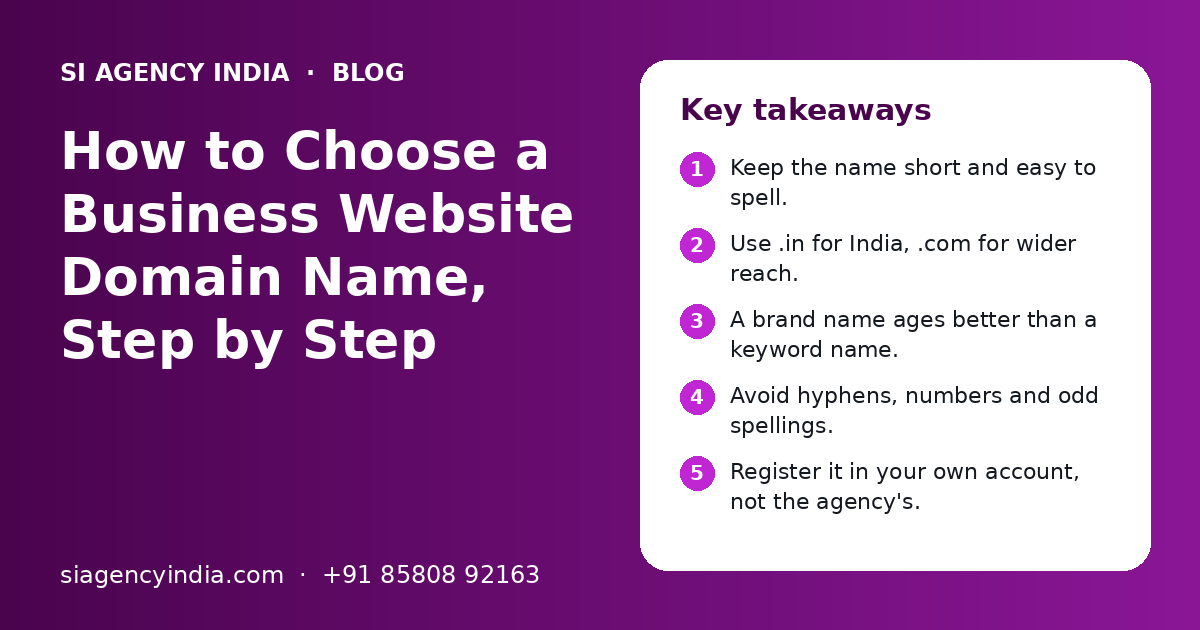
Key takeaways
- Keep the name short and easy to spell.
- Use .in for India, .com for wider reach.
- A brand name ages better than a keyword name.
- Avoid hyphens, numbers and odd spellings.
- Register it in your own account, not the agency's.
- Turn on auto-renew so it never expires.
What is a domain name and why does it matter for a business?
A domain name is the address people type to reach your website, such as yourbrand.in or yourbrand.com. It matters because it becomes part of your brand, your email address and your marketing, and it is hard to change later.
Many owners pick the first free name they see. That is a mistake. Once the name is on boards, bills and visiting cards, a change costs time and money.
Before you learn how to choose a domain name for a business website, note that the domain is not the website itself. The website files sit on hosting, and the domain points people to it. You can change hosting later and keep the same domain. If you are planning a new site, our page on website design in India explains what the full project includes.
.in vs .com vs .co.in: which extension should you choose?
Choose .in or .co.in if most of your buyers are in India. Choose .com if you sell to other countries or want a global feel. If both are free, many businesses buy both and point one to the other.
The .in extension is the country code for India. Its registry is run under NIXI, the National Internet Exchange of India. The .com extension is open to anyone in the world and is the most familiar to most people. The .co.in extension is a second-level option under .in and is meant for businesses.
| Extension | Best for | Points to note |
|---|---|---|
| .in | Businesses that mainly serve buyers in India | Short, clearly Indian, and good names are often still free |
| .com | Businesses with buyers in many countries, or online brands | Most familiar to people, but short names are often taken |
| .co.in | Indian companies and firms | Clearly business-like, but longer and a little harder to say |
| .org / .org.in | Trusts, NGOs, associations | Signals a non-profit, so avoid it for a normal business |
Does the extension affect Google ranking?
The extension alone does not make you rank higher. Good content, a fast site and real reviews matter far more. A country extension like .in does tell search engines that your site is meant for India. That helps if India is your market, and it may limit you a little if you want buyers abroad. Our SEO services page explains what actually moves rankings.
What makes a domain name easy to remember?
A good domain name is short, easy to say on a phone call and easy to spell after hearing it once. If you have to spell it out every time, it is too hard.
Try the phone test. Say the name to a friend once, without spelling it. Ask them to type it. If they get it right on the first try, the name works. If they ask "with a double s?" or "is it 4 or four?", change it.
- Short: ideally two or three simple words or fewer
- Easy to spell in English after hearing it once
- No hyphens, which people forget to type
- No numbers, which people write as words or digits
- No double letters at a word join, such as "pressservice"
- Does not read as a rude or odd word when the words join
- Sounds the same in Hindi, Punjabi or your local language
- Matches your business name or brand closely
Also write the name in small letters with no spaces and read it slowly. Some joined names create unwanted words.
Brand name or keyword name: which is better?
For most businesses, a brand-based name is better than a keyword-stuffed name. A brand name builds trust and recall, while a keyword name like best-cheap-tiles-delhi.com looks spammy and limits you if you grow.
Search engines look much more at the content and quality of a site than the words in its domain. A keyword name can also box you in. If you start with "tiles" and later sell sanitary ware, the name no longer fits.
Brand name (e.g. sharmaceramics.in)
- Builds trust and is easy to recall
- Works on boards, cards and social media handles
- Still fits when you add products or cities
- Harder for others to copy
Keyword name (e.g. best-tiles-shop-delhi.com)
- Looks less trustworthy to many buyers
- Often long and needs hyphens
- Stops fitting when your business grows
- Gives little or no extra ranking benefit
When a short keyword helps
A light mix can work. Adding one clear word to your brand, such as "sharmadental" or "guptalegal", tells people what you do and keeps the name short. Adding a city name can help a purely local business, but it can feel limiting if you plan to open more branches. For local search, a proper Google Business Profile and local SEO matter far more than a city in the domain.
Need help with your project?
Talk to the SI Agency India team. Free first call, simple advice, clear quote.
How do you check that a domain name is safe to use?
Check three things before you buy: that the name is free to register, that no one holds a trademark on it in your field, and that the matching social media handles are free. This takes less than an hour and can save you from a forced name change later.
- 1
List 5 to 10 name ideas
Start from your business name. Write short versions, versions with one added word, and both .in and .com options.
- 2
Check availability
Search each idea on a known registrar's website. Note which extensions are free.
- 3
Search the trademark records
Search the name on the official Indian trademark search, which is on the IP India website, and look for marks in your field. If you sell abroad, check those countries too.
- 4
Search the web and social media
Search the name on Google, Instagram, Facebook, YouTube and LinkedIn. Make sure no well-known business already uses it.
- 5
Check the domain's past
If it is an old domain that has expired, look at what it was used for. A name once used for spam can carry a bad history.
- 6
Do the phone test
Say the shortlisted names to a few people and see which ones they type correctly.
- 7
Buy and lock
Register the final name in your own account, turn on auto-renew and the registrar lock, and save the login safely.
Who should own the domain: you or your agency?
You, the business, should always own the domain. It should be registered in your own registrar account, with your company or owner name and your own email and phone number as the main contacts.
A common problem: a web designer or employee buys the domain in their personal account, then leaves or stops replying. The business cannot renew the domain, change the website or move the email.
| Item | Who should control it | Why |
|---|---|---|
| Registrar account login | Business owner or a partner | Only you can renew, transfer or lock the domain |
| Registrant name | Your company or your name | Shows legal ownership of the domain |
| Contact email | An email you will keep for years | Renewal and transfer notices go here |
| Payment method for renewal | Your business card or account | Renewals do not fail when a staff member leaves |
| DNS access for the agency | Shared access or a separate user, if the registrar allows | The agency can do its work without owning your name |
A good agency will build and manage your site while the domain stays in your name. When we work on a WordPress website or a Shopify store, the domain stays with the client.
How do renewal, auto-renew and domain privacy work?
A domain is rented for a fixed period, and you must renew it before it expires. Turning on auto-renew with a valid payment method is the simplest way to make sure you never lose it.
When a domain expires, your website and business email stop working. Most registrars give a short grace period, but the rules vary. After that, the name can be released and someone else can buy it.
- Turn on auto-renew and keep the saved card or payment method up to date.
- Use a contact email that is not on the same domain, such as a personal Gmail of the owner. If the domain expires, you can still read the reminder.
- Turn on the registrar lock (transfer lock) so no one can move the domain without your approval.
- Turn on two-step login for the registrar account.
What is domain privacy?
Domain privacy is a registrar service that hides your personal phone, email and address from public domain lookup records. Whether privacy is offered, and how it works, depends on the registrar and the extension. Check this when you buy. Even with privacy on, make sure your real details are correct inside the registrar account, because those are used to prove ownership. Keeping all of this in order is part of good website maintenance.
What should you do after you buy the domain?
After you buy the domain, secure the account, connect business email, point it to your website and keep a simple record of all logins. Then use the same name everywhere so buyers find you easily.
- Turn on two-step login, auto-renew and the transfer lock.
- Set up business email on the domain and test sending and receiving.
- Point the domain to your hosting or website builder and add an SSL certificate so the site opens on https.
- If you bought both .in and .com, point one to the other so there is only one main site.
- Add the domain to your Google Business Profile, WhatsApp Business profile and social media bios.
- Write down where it is registered, the renewal date and who has access, and keep this note safe.
Domain and hosting are only a small part of a website budget, but the full cost depends on design, pages and features. Our website cost in India guide explains what affects it. If you want to know how long the full build takes after the domain is ready, read how long it takes to build a business website.
SI Agency India is powered by Shivah Web Tech, with 11+ years of work, a 25+ in-house team and 500+ projects. If you want help picking and setting up a domain for a new site, contact us. You get a clear quote after a free call.
Frequently Asked Questions
Is .in or .com better for a small business in India?
If almost all your buyers are in India, a .in domain is a good choice. It is short, clearly Indian and good names are often still free. If you sell to other countries, or want a global brand, .com is more familiar. If both are free and within budget, many businesses buy both and point one to the other main site.
Does having keywords in my domain name help SEO?
Keywords in the domain give very little ranking benefit today. Search engines look much more at your content, page speed, links and reviews. A keyword-heavy name can also look spammy and stop fitting when your business grows. A short brand name, maybe with one word that says what you do, is usually the safer choice.
Should I use hyphens or numbers in a domain name?
It is better to avoid both. People often forget to type hyphens, and they may reach another site. Numbers cause confusion because people do not know whether to type the digit or the word. When you share the name on a phone call, you would have to explain it every time. Plain words work best.
Who should register my business domain, me or my web designer?
You should. The domain must be in a registrar account you control, with your business or your own name as the registrant and your own email as the contact. Your web designer can get shared access to change settings, if the registrar allows it. This way you can always renew the domain or change agencies without any trouble.
What happens if my domain name expires?
When a domain expires, your website and business email stop working. Most registrars allow a short period to renew after expiry, often with extra charges, but the rules vary. If you still do not renew, the name may be released and anyone can buy it. Turn on auto-renew and keep the payment method updated to avoid this.
How do I check if a domain name is already trademarked?
Search the name on the official trademark search available on the IP India website and look for marks in your type of business. Also search Google and social media for businesses using the same name. If you will sell abroad, check those countries too. If you find something close or you are unsure, speak to a trademark lawyer before you buy.
Can I change my domain name later?
Yes, but it takes work. You need to move the website, set up redirects from old pages to new ones, update Google tools, change your email and reprint cards and boards. Search rankings can dip for some time during the move. It is much easier to spend an extra day choosing the right name at the start.